


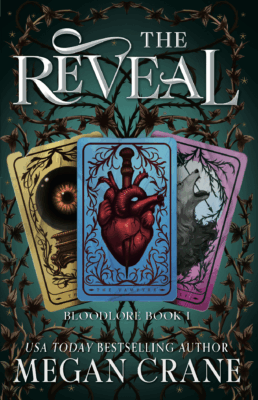
The Reveal
Book 1 in the Bloodlore Series
In the wake of a monstrous world war, a mortal woman’s submission to an enigmatic vampire is the only way to live in this enthralling paranormal romance by a USA Today bestselling author.
THIS KIND OF DESIRE COULD BE THE DEATH OF HER.
It’s a different world now, Winter Bishop. Get used to it. Or die.
In the three years since the Reveal, when monsters rose from the shadows, I’m just another human trying to maintain normalcy in a world where life is short and brutal. Co-existing with werewolves, zombies, and vampires—each alarmingly true to their myths—isn’t easy.
Now I’ve been summoned by Ariel Skinner, the charismatic king of the vampires, who holds my missing brother’s life in his hands. To save him, I must do everything Ariel says. His quicksilver gaze and the way he makes my body hum should scare me, but the wildfire chemistry is just too hot.
I should have known that Ariel would want more.
Because there’s a greater cataclysm to come and it will make everything worse. To help stop it, Ariel needs me. And whatever fresh hell arises, with every beat of my disastrously mortal heart, I need him.
After all, I’m only human.
 Book 2
- ROMANTIC THEMES: Bad Ass Heroine, BDSM, Bad Ass Alpha, Cult Leader Hero, Dystopian Romance, Enemies to Lovers, Erotic Romance, Fantasies Made Real, Friends as Family, Girl Next Door, Good Girl/Bad Boy, Heroine On the Run, Immortal Lover, Meddling Relatives?, Oracle Heroine, Paranormal, Playboy Hero, Things That Go Bump in the Night, Vampire Hero, Warrior
Start reading
The Reveal
Jump to Buy Links →
Listen to the Audio Excerpt →

ROMANTIC THEMES:
- Bad Ass Heroine
- BDSM
- Bad Ass Alpha
- Cult Leader Hero
- Dystopian Romance
- Enemies to Lovers
- Erotic Romance
- Fantasies Made Real
- Friends as Family
- Girl Next Door
- Good Girl/Bad Boy
- Heroine On the Run
- Immortal Lover
- Meddling Relatives?
- Oracle Heroine
- Paranormal
- Playboy Hero
- Things That Go Bump in the Night
- Vampire Hero
- Warrior
Explore The Bloodlore Series →
INSPIRATION:

Chapter One
There are zombies in the trash again.
Twice already this morning and it isn’t even light yet.
I punch my pillow and stop pretending I’m asleep. Who sleeps these days? That’s a luxury I barely recall. I wake up from something resembling bad sleep every morning with a headache, my skull like an egg with a tender shell that’s threatening to crack open. Thank you, terrible nightmares that plague me all night long, starring hideous creatures who call themselves dark goddesses while committing unspeakable acts upon my person.
So really, the zombies outside feel like a delightful escape from my own head.
I get up, scrub the not-enough sleep from my eyes and mutter the same thing to myself I do every time I live to see another morning. “Monsters are real and they will eat you without a second thought. Act accordingly.”
A happy little mantra for life three years into the Reveal, because this is actually what lucky looks like.
What it feels like is complete shit, but you get used to that. Or you die.
I shrug into my usual uniform, strategically left on the floor last night by yours truly. Makes it easier to access, should something attack. Cargo pants to carry the necessities, like extra ammo, because no one goes anywhere without extra ammo. And whatever T-shirt I remembered to wash, because it’s still hot at the end of September here in Southern Oregon. I strap on my knives and stick one in each boot. Then I move to the windows we boarded up three years ago, even up here under the eaves. I do a quick check to make sure nothing is loose, because monsters are crafty and relentless, the creepy fucks, and a loose board might as well be an invitation.
Through one of the old bullet holes, I look out into the yard behind my grandmother’s house. It’s littered with an old van my parents claimed they were remodeling, but never did, and four other broke-down cars no one ever claimed in my hearing. There’s something that looks like farm equipment, though no one in my family has ever farmed anything. Everything is covered in the weeds that no one’s cut in three years, because who has time to care about lawns. My gaze lingers on the remains of the vegetable garden that something dug up the last time I tried planting—leaving claw marks the size of my torso.
That ended my fantasies of freshly grown vegetables at our house.
“Cans over claws,” I mutter, because I talk to myself now. A lot.
Maybe I always did, but back in the before time, I hid it better.
I reach for the BB gun my granddad used to shoot raccoons and pigeons out back when I was a kid. I’d love to see an adorable little raccoon, as a palate cleanser, but no. It’s zombies.
But at least it’s better than my nightmares. And my headache is beginning to ease its tight grip on my temples as I look outside, like real monsters are better than the ones in my mind.
I see them out there in the predawn light, snuffling and thrashing and moaning around in the trash enclosure. The lock on that gate never holds, no matter what I try, so I always have to run them off myself. Zombies are harmless enough, relatively speaking. They want dead things, spoiled things. Not brains. Not blood or living flesh. Mind you, they move slow enough that you could turn into dinner—fully dead and spoiled— before they decide to shuffle on.
I don’t like that I’ve become an unwilling expert on this subject. But there are a lot of other things I like a lot less these days, so I don’t dwell on it.
Or I try not to dwell on it.
I load the gun without thinking about it, then I fire. Pop pop pop and the zombies do their slow-motion scatter, heaving themselves across the overgrown yard. I fire off a few more shots, just to be sure, but they shamble away into the trees right as the sun comes up, sending golden light to dance through the lingering wildfire smoke.
It’s pretty. The oranges and the reds remind me of the kinds of things Augie used to paint—

But thinking about my twin brother hurts, so I shove it aside. I put the BB gun back on the shelf by the window and leave the attic, running down the narrow stairs that lead to the rest of the house. I can already hear my grandmother muttering to herself. She likes to sit by her window and play with her creepy oracle cards every morning, but I know that in a minute or two, she’ll start shouting for me.
If she remembers me today. If not, she still shouts but she doesn’t use my name.
More stuff I try not to dwell on.
I check all the possible entrances and exits in my attic room to make sure they’re secure. I jog down the stairs and do the same on the second floor, taking in the way the sunlight creeps around the edges of the boarded-up windows, beams of light shooting into the three bedrooms that line the hall. It’s the only thanks I’ll get for scouring them of any remnant of my parents, my brother, and Gran’s crafting room, which was filled with way too many unnerving little items I wish I didn’t know were there all along, that near to where I sleep—or try to sleep through the dark things in my head, anyway.
I try to look at the house like a stranger would as I head down the main stairs, to get a full sense of all the changes I’ve made. I’ve spent the past two weeks cleaning the hell out of it, so it would match the cottages I’ve overhauled out front. It’s not just the past three years of panic and hunkering down that were packed into this place, it’s the lifetimes that came before. There were fingerprints all over this house my great-grandfather built with his own hands, and I wiped them all off myself.
Besides, cleaning out the rooms means I have better vantage points over the handful of cottages that are scattered out in front of the house in the big, wide yard that keeps the woods at bay. They were built at various times by various relatives of mine, and have served many purposes over the years. It’s taken me a long time to clean them out and turn them into rustic little dwellings, working on them in what few spare moments I could find.
Something I never would have done if I didn’t think it was necessary.
Welcome to life after the end of the world, at least the one I knew. There are no good choices. Only bad ones, worse ones, and deadly ones.
I make it to the ground floor and pause by my grandmother’s door, but she’s deep into her muttering. My headache is still kicking in my temples, and the muttering doesn’t help. So I walk through the living room and the old, formal dining room, big and echoey around me now. It’s hard to get used to. I haven’t heard the floorboards squeak like this since I was small. That’s how long it’s been since anyone hauled all the crap out of here.
Some of it I packed away in the sheds out back, working fast in whatever sunlight there was. Some of it I burned in the firepit with all the monster bones. Some of it I couldn’t bear to get rid of, so I used it to furnish the cottages. The rest I found places for upstairs in the now airy, empty bedrooms. I touch the medallion around my neck that I took from Augie’s room, the one he never took off until he did, and hate that I still want to feel connected to him.
I know he doesn’t want that. He’s proved that enough times.
He doesn’t want anything but the vampire blood that keeps him high, somewhere down by the river with the rest of them. Those lost souls who lived through the first catastrophic rush of the Reveal, then decided that a living death was better than figuring out how to go on.
Not that I had a choice about that, either.
I go into the kitchen through the metal door I installed—with a locking system that would make a feudal lord jealous and will more importantly keep the rest of the house inaccessible to any tenants—and make the bitter coffee I like because it tastes like my feelings. And usually helps clear out my morning headaches, too. I doctor Gran’s with that powdered creamer that might be the only thing she truly loves. She’s already squawking by the time I make it through her door, and she doesn’t stop when she sees me. She points down at her cards instead.
I hate those cards. Old, weathered, long-used cards that my grandmother has always claimed let her see. Whatever that means. They’re dark-colored—or they were, once, long ago—with strange symbols on the backs and even stranger drawings on each cardface. Looking at them always makes me feel funny, like I’m standing on some high cliff and might topple off at any moment.
But there’s no telling Gran that. She says the cards are a sacred family heirloom that I will appreciate in time.
I don’t have the heart to tell her that like most of our family heirlooms, all of which I cleaned out of this rickety old house, they’re junk.
“You have a reckoning coming, Winter,” she tells me loudly, squinting at me, and I feel the usual relief that today is another day she remembers my name, because those are getting scarce.
Reckonings can bite me like everything else that tries.
I set her coffee down. “Before or after I get you to the bathroom, Gran?”
She sniffs, but she lets me help her up. Then we take care of her usual morning routine. I don’t mention that she seems more frail, or that she can walk fewer and fewer steps each day. I tell myself I’m protecting her, but I know better. As long as she can get herself from the bed to the chair, we can both pretend she’s independent.
Some days I’m not sure which one of us is doing more of that pretending.
I settle her in her chair again when we come back so she can slurp her coffee. I make her bed because she complains if I don’t.
“Remember what I told you,” I say, though I don’t expect her to remember. Her memory took off right around when my parents did. That was maybe a month before the Reveal, and it was a blessing, in its own way. For a while, Augie and I told her they were on their way back from the store.
Now she thinks he is.
I wish I didn’t know better myself.
She frowns at me suspiciously, a little gnarled root of a woman in a chair that dwarfs her. Her frail little ankles stick out from beneath her nightgown because she likes slippers, not socks, and I find the sight of them heartbreaking the way I always do.
“I remember,” she says, the way she always does.
“We’re going to have some new people around,” I tell her in this weird, cheerful voice I only use in her room. Neither one of us buys it but I can’t stop. “I’m finally renting out the cottages. It’s going to be fun.”
She scowls at me, clearly not remembering that it was initially her idea that we open up the cottages to neighbors in need after the monsters started burning people out of their homes. “My mother always said that only a dire house takes in strangers.”
I want to tell her that the house is dire as is. That it was so dire that cleaning it out made me feel as close to actual tears as I think I’ve ever been, and I’m the stern twin. That was what Augie always called me. I was the stern one and he was the sensitive one, but that’s another dire thing, because now he’s too sensitive to live and I’m so stern it might kill me.
I don’t tell her that.
I want to tell her about my meeting with Franklin Hendry, the local mortgage broker who is my father’s age and once dated my mother when they were kids—according to him, and she’s not around to confirm or deny—at the bank at the end of last month. I want to share with her how dire that was. It’s the end of the world in real time but Franklin Hendry’s out here ruining what few lives remain. I could tell her that it never occurred to me that anyone would come for the bills when there hasn’t been an internet or cell phone service in years, or even any way out of this valley.
But Franklin Hendry was not devoured by the werewolves who cluster in the hills around the still-standing historic town of Jacksonville and no longer wait for full moons to change shapes. He was not exsanguinated with sneering contempt by the vampires who came out of the shadows and never went back in. He apparently avoided whatever that horrible, clawed thing is that tore up my vegetable garden.
Some monsters are human, and this one has given me a deadline. I have until Halloween to pay off the back mortgage or Franklin Hendry is throwing us out.
I don’t tell Gran that it’s not me I’m worried about. It’s her. I’d love to tell Franklin Hendry to go fuck himself, but I can still pretend there are things I might outrun, given enough of a head start. She can hardly walk.
Taking in a few tenants is the least of all these evils. If I could find my manager at the drive-through coffee hut on the road that heads south, toward Ashland, I would officially ask for more hours and a raise, but no one’s seen poor Doug in months. Someone stocks the place, though. And I still get an envelope of cash every Friday. That’s the only reason I still show up. That and because I like a routine that feels normal when nothing else does, or ever will be.
Also, it turns out monsters like caffeine like anyone else.
I don’t tell Gran any of this. “It’s a new adventure,” I say instead, brightly. “When I was a little girl you always told me that being afraid of new adventures was my cross to bear.”
Gran frowns at me in that censorious way she never used to, but it’s better not to think about the past. The good memories are harder to deal with. At least I know I survived the scary shit when the Reveal hit. It’s not a happy ending but it’s something.
“I would never say something like that to my own daughter.” She huffs at me. “I raised you better than to tell such lies, Lilianne.”
I lean over and kiss her on her soft, wrinkly cheek. I stack her books and those battered, spooky old cards on the table beside her. I don’t tell her I’m not my mother.
“Besides,” Gran says in that dark, knowing way she does sometimes, “you never had the gift. It would be cruel to taunt you.”
Sometimes my grandmother creeps me out more than the monsters roaming the valley—and the world—but I try not to let that get to me. Just like I try not to think about all that weird shit she had in her craft room. Gnarled old roots and creepy little figurines that looked a little too much like the shapes and symbols on her cards, no thank you.
“It’s light out,” I mutter. “I’ll be back in a couple of hours. Blow the horn if you need help.”
I give her the usual song and dance as I place the air horn on the table, within reach. I don’t know if she’ll remember to blow it. I don’t know if the neighbors will come running the way they claimed they would. I don’t even know if the Petersons made it through the night last night, or over the past week, because I haven’t actually seen them in a while.
But when everything is uncertain, it’s like nothing is. I act like what I want to be true is a fact. Because what else can you do?
Then I slip outside, making sure all the bolts and gates are shut tight behind me. I keep my weapons primed and ready as I head for my truck, scanning the yard for any incoming threats. I also look at the three cottages tucked into the edges of the woods, all of them rustic, certainly, but a lot nicer than they used to be. Not something that can be said about much else these days.
I don’t exactly hold my breath, but I don’t really exhale fully until I’m in the driver’s seat, the engine’s running, and everything’s locked. Better yet, until nothing blocks my exit out our drive and onto the road that leads into town.
I used to love this drive. It winds through the woods, cutting its way down a neighborhood tucked into a hillside, into the main part of Jacksonville. Jacksonville itself is a perfectly preserved western town that looks like Old West cowboys should come swaggering out through the doors of the old saloon, though these days, if they did, you’d have to accept that they were vampires. Growing up, it was filled with cute boutiques, festivals, restaurants, and a trolley that took tourists into the Applegate Valley wine country outside town.
But now the Applegate is overrun with monsters. Vampires feasted on the big megachurch out that way, gobbling up most of the parishioners one bloody Sunday. No one knows what happened to the wineries. I’ve heard rumors that there are human settlements way out by the lakes, where the California border lies and the gulches are easier to defend, but no one knows that for sure.
Jacksonville fared better. It was designated the only human-safe space in the valley about eighteen months ago by the powers-that-be in this valley, most of them monsters. Supposedly, we can walk around free of fear and don’t have to worry about getting eaten. Or being dragged off to be someone’s plaything in sick games I’d rather not think about too closely.
At first, no one believed we could ever be safe. Then we all got a little too comfortable with it. Every now and again there’s a monster who forgets the rules and we all get vigilant again for a few days. The truth is, life is much shorter and more brutal than it used to be. We always come back out in the open.
This morning there are already people walking around, basking in the illusion of all that safety.
I slow the truck when I hit the main street because I see Samuel Ruiz on the corner. Samuel is a few years older than me. He was a football player in high school and went on to play for the Ducks, which people cared about back then. Now he’s basically the mayor and the entire city council of Jacksonville.
“Nice to see you out and about, Winter,” he says into my window when I roll to a stop beside him. His voice is low and perfect and his eyes are still green. Still so ridiculously green.
That’s his way of saying, nice you’re not dead. And maybe more than that, I like to think. Maybe he’s also saying he’s glad I’m not dead.
“I’m going to do a few hours at the coffee hut,” I say, stupidly, because I’m sure he knows where I’m going. There aren’t that many people. We know each other’s routines because knowing them means we also notice when you get dead.
He still has that same football body, I can’t help but note. I’m not dead, not yet. And neither is he. He looks at me in that piercing way he has, then shifts that gaze to sweep for monsters and nod hello to other humans. Like a normal person would.
Like I should, but I don’t.
“Jenny tells me you’re taking in renters,” he says, and then all that green is on me again. “Be careful. You don’t want to wake up with a monster under your roof.”
“Will the monster pay the rent money on time?” I ask, and he actually laughs, and I don’t think about much else all morning.
Not even when a pair of hungry-looking vampires take advantage of the smoke that’s filled the valley over the course of the morning, turning everything a choking gray. They don’t have to worry about bursting into flame in the sunshine when the smoke strangles it, so they come at the window of the coffee stand and only back off when I turn the holy water squirt gun on them—the best thing ever found in the ruins of the local church by one of my coworkers, and left here to keep the vampires in line.
I watch them run and jump into a very nice Escalade they likely took after feeding on the poor driver—whoever he was—then peel out.
Then I think about Samuel some more. And more specifically, that day in the first year after the Reveal when Jacksonville’s remaining humans actually crept out and met up for the first time. He’d organized that. He’d been the one to get everyone thinking about community again, instead of just hiding away by themselves. Then later he’d walked me home, up the hill to say hello to Gran, and he’d stayed.
I remember his mouth on mine in the dark of the crowded living room, piled high with crap and fortifications. I remember his body pressing me down, and how I’d wound myself around him like I was clinging to him for life.
It had been a dark, hot rush and sometimes I think I dreamed it.
I hate dreams—they’re why I prefer nightmares. Nightmares let you know where you are, that being some or other version of hell, and usually come in with a killer headache to make sure you’re paying attention. Dreams pretend you could be somewhere else.
I especially hate dreams that were never talked about and never happened again, though I still catch him looking sometimes. Like today.
I tell myself he was definitely looking today.
At midday, I go home because the Jenny he mentioned is his sister and she runs the paper, because we have a paper again now. There’s power—no one has ever explained how—but no internet, no TV, no radio. All of that blew up. Or someone ate it, who knows. Jenny’s been collecting news for the past couple of years and passing it out all over the valley in the armored truck she got from one of the banks that didn’t make it.
That’s how I advertised for renters right here in the human safety zone.
I get home, I check on Gran and get her settled again, and then right on time, at 12:30, when I advertised that I’d talk to any cottage-rental hopefuls, there’s a knock on the front door.
I open the door, but not the metal gate, and stand there with my guns drawn, the way I’d greet anyone.
But this isn’t anyone.
This is a girl my own age.
A girl I recognize.
A girl I haven’t thought about in a long time, because she was one of the few who got out. Back then, it wasn’t monsters that kept people in the valley, it was not having money or sufficient imagination, take your pick. People hit ceilings in a place like this and stay put. And often wither. My parents are a prime example of that kind of surrendered life.
Maddox Hemming had never seemed like the college type. Too… physical. Slinking around with her wild hair, covered in tattoos, she was always followed by a pack of boys who couldn’t seem to decide if she was one of them or their queen. I’d assumed she was having the sort of glorious adolescence I certainly wasn’t.
That was a long time ago. Now it’s three years past the Reveal and I see the truth about Maddox isn’t that she’s secretly an academic, despite her defection to her fancy East Coast school.
Maybe she’s that too.
But the important thing about Maddox Hemming is that she’s a werewolf.
And, I now realize with a kind of horror mixed through with something not exactly admiration, always was one.
Because these days I know what a werewolf looks like in its human form—another gift of the Reveal. The way they hold themselves. That wild hair. And eyes that gleam gold when the light hits them just right.
She smirks at me. That’s when I realize I’ve cocked both guns.
“Damn, Winter,” she drawls, like this is a casual conversation in the bathroom of the old high school that someone burned down last year. Like she isn’t a monster. Like I’m not pointing weapons at her face that she must know I’m fully prepared to fire. “That’s an aggressive way to interview a potential renter. No wonder you have space to spare.”
End of excerpt
Audio Excerpt
The Reveal
Rebel Heart Books is my absolute favorite bookshop. I'd love it if you'd support this delightful, woman-owned place. You can also get signed copies! Check here to see if this book is available through them.


The Reveal
is available in the following formats:


