
Sicilian Devil’s Prisoner
Is she his ruin…
or his redemption?
Jovi D’Amato doesn’t show mercy. He is ice cold, ruthless and relentless. He is the deadly weapon of the Il Serpente crime syndicate, forged in the brutal aftermath of his family’s murder. Then he’s sent to kidnap Ruxandra Ardelean. In a single heartbeat she detonates his entire existence…
Salvation isn’t something Rux thought possible until Jovi takes her prisoner. The dangerous Sicilian should terrify her. Instead, he thrills her. She comes alive under his shamelessly sinful touch. Though for Jovi to make her his, he’ll have to burn his whole world down…
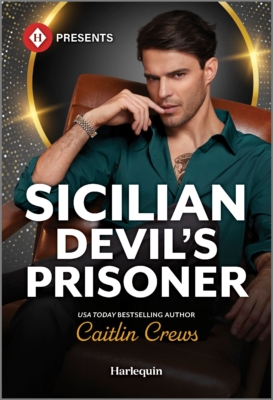
Start reading
Sicilian Devil’s Prisoner
Jump to Buy Links →


CHAPTER ONE
Quannu u diavulu t’alliscia voli l’arma.
If the devil pays you compliments, he wants your soul.
–Sicilian saying
Birds sang in the thick green trees as they danced through the dense, overgrown gardens outside the magnificent old villa some thirty minutes from the center of Palermo, Sicily. But what Giovanbattista D’Amato—called Jovi by the few who dared address him directly—noticed despite their chatter were the sounds that should not have been there, soft beneath the usual noises he knew so well.
It seemed he had a guest.
When he was not the kind of man who encouraged visitors, especially of the uninvited persuasion. Something that must surely be clear by the untended sprawl of gnarled oleander and fig trees that had grown up around the gates down near the road and made the entrance to the villa seem all the more secretive and, therefore, more provocative.
The villa was perfectly preserved and stunning, as everyone always whispered in shocked tones, despite everything. Teenagers and tourists who thought they might poke around a place with such a riveting, tragic past were usually scared off by their own overactive imaginations long before they made it to the villa’s front door.
The ghosts that haunted the villa and its quiet slide toward a graceful, genteel ruin knew only too well how to occupy a mind and sneak deep into an unguarded moment.
Jovi knew that better than anyone.
He heard the car out in the front of the villa, on the winding drive that had given way to the demands of changing seasons and the scrubby mountainside that stretched above and below, though nothing could conceal the bones of the estate, a crowning achievement of the Sicilian Baroque period. Neither time nor negligence could dim its glamour in the slightest.
Jovi had certainly tried.
He heard the slam of the car’s heavy door, yet he stayed where he was. He sat perfectly still in the shade of the towering oak tree some gardener long-dead had planted here in another lifetime, as if he was contemplating nothing more than the easy mysteries of a warm, Sicilian afternoon.
But that was only the impression others might form if they saw him here, sitting so quietly.
And only those who didn’t know him.
Because anyone who knew Giovanbattista D’Amato knew exactly who and what he was. Ice, straight through.
Ice where other men were flesh. Ice in place of organ and bone.
He remained still. He supposed that it was possible that somewhere, back in the dimness of the youth he did not allow himself to recall too closely—or too often, lest he give those ghosts free rein—he had gone ahead and taught himself these skills he used without thought, now.
The ability to sit so still that the birds themselves mistook him for a statue. A stone like any other.
The capacity to wait. To do nothing else. To simply wait, without moving. Without breathing too much, lest it make his chest move and differentiate him from the stone walls. To easily parse the various sounds that reached his ears. The birds. The breeze and the trees above. The rustle of small creatures in his gardens, long since surrendered to riots of rogue blossoms and weeds—a rebellion against the meticulously maintained, award-winning planting concepts that had once been synonymous with the villa and its residents.

He identified all of those, set them aside, and listened for the heavy fall of a man’s leather shoe inside the graceful, empty rooms of the once-proud villa that rose up behind him.
Jovi did not lock the place. Why should he? Terrible things had already happened here and there was no pretending otherwise. There was nothing to steal that he could not replace, assuming that he could be bothered. To his way of thinking, anyone was welcome to drop in. Unannounced and heavily armed, if they wished.
Though they might wish otherwise. Quickly.
He was not concerned about people entering this place where he lived when he was in Sicily. Because he knew that the difficulty was not in the entering. But in the leaving.
Once someone invaded his space, they would leave it again only if he wished it.
His were the only wishes that he would allow to prevail on this sprawling parcel of land, set up on the rugged mountainside, claimed by men who must have imagined it was ever truly possible to escape the chokehold of Sicily.
Jovi knew better.
He heard feet on one side of the duel staircases in their Sicilian Baroque style, all high drama as they marched away from each other and then angled back to meet at the great door.
And as the footsteps drew closer, he heard the faintest sound. Like a rough laugh, checked before it was anything more than a breath.
No need, then, to worry about his response.
He waited instead. And when the footsteps drew even closer, barely making scraping sounds across overgrown flagstones crafted by the finest stonemakers in Sicily and left to the whims of the sun, there was another laugh. This one untethered, likely because its owner thought he was alerting Jovi to his presence.
The way he always did.
“I don’t know how you live in this haunted place,” came the intruder’s familiar, disparaging voice.
Not an intruder, Jovi corrected himself. Not exactly.
He did not bother to turn around. He knew who his uninvited guest was. Had known, in truth, the moment he’d heard that particular heavy cadence of footfalls from inside the villa.
Carlo D’Amato, his cousin. His oldest cousin and his uncle’s favorite son. This meant Carlo was also considered the sotto capo of what some news organizations liked to call the D’Amato crime family, but only because they dared be disrespectful from the distance afforded them through newsprint.
To those who knew better than to show disrespect, they were known as Il Serpente, wily enough to outwit the many criminal investigations that had plagued families like theirs since back in the 1800s. Not to mention the rival criminal organizations who muscled in where they could.
Most shivered at the very thought of Il Serpente, a true family organization built on blood ties, because blood brokered loyalty. Blood was less likely to be bought.
Jovi was a part of this family, but not the way Carlo was. Because Jovi’s father, the traitor Donatello, had betrayed his own brother—bringing dishonor to the family name and very nearly handing them all over to the authorities who stalked them.
This was a stain upon them all. Jovi alone of his father’s family had been spared.
So he was family, yes. Blood where it counted. More importantly, he was a weapon.
The weapon, perhaps.
“Did you hear me?” Carlo’s voice rose in pitch as he swung himself around the chair so he could look down at Jovi from the front. Allowing Jovi to watch, fascinated as always, as this big, powerful man who feared nothing and no one—a fact Carlo liked to broadcast whenever possible—looked more than a little wary at the sight of his supposedly lower-ranked cousin.
The way everyone did if they had the misfortune of seeing him.
Because there was rarely any reason to see Jovi that did not involve pain.
Carlo, as ever, could not hold Jovi’s gaze. He looked away, and his shoulders hunched, more signs that he was intimidated by the cousin he liked to brag that he did not find frightening in the least.
He even spat on the ground, as if Jovi was a superstition in need of clearing. “You’re a spooky stronzo,” he muttered.
Jovi only waited. Carlo knew exactly why Jovi lived here. This was the home Jovi’s father had inherited from his own father, as he had been the oldest D’Amato son in his generation. Donatello had been too soft for the family business, however, according to the stories everyone liked to tell. Jovi’s grandfather had used to say that he had two heirs.
Donatello for the public family legacy, charming and academic and sophisticated. And the crafty, cunning, and wholly soulless Antonio for the family business, where sophistication was not required but brutality was celebrated.
Antonio had wanted nothing to do with this place after he had meted out bitter family justice upon Donatello, his wife, and his two young girls.
Jovi did not allow himself to think of them in other terms. His father and mother. His sisters.
They had all lost the right to those connections when Donatello betrayed their family.
He rarely permitted himself to think of them at all.
It was his cousin who seemed to enjoy bringing up ancient history whenever he came here, always pointing out the empty, echoing rooms. Always making certain to remind Jovi of the things he opted not to remember. Or, perhaps, reminding Jovi of his roots in the only way he could without risking Jovi’s displeasure.
Despite what Carlo liked to tell the rest of Sicily, and likely himself, both Jovi and Carlo knew very well that Carlo would never dare to actually insult his cousin. Here, in these private moments, Carlo’s cowardice was always clear.
Carlo swallowed. Then took his time looking Jovi’s way again. “Patri has a job for you,” he said.
This, too, was obvious. Only a directive from Antonio himself could compel Carlo to visit this place of shame and despair, a stain upon the family name. There was no possibility that Carlo would ever come here to spend time with Jovi, to catch up or whatever it was people did when they had all of those social connections Jovi had never been permitted.
Even if Carlo wasn’t terrified of Jovi, they would never connect in this way. Jovi shared blood with his family and their ancestors, here in Sicily and across the water in Calabria.
He did not share anything else.
That would require that he be made of something more than ice, and his uncle had made certain that he remained too cold to melt. Ever.
In truth, he preferred it that way.
Sometimes Jovi walked through the crowded squares of Palermo or drove past the beaches in summer. They were always teeming with people having their coffees and their harder drinks. Talking loudly, waving their hands in the air. Clustered together over tiny tables in public spaces or flung about in abandon on the sand, entirely unaware of their surroundings or what sort of monsters might be waiting there, watching.
Looking for a chance to strike.
He could not understand it.
Yet Jovi knew his cousin not only understood these things, but enjoyed them. Carlo maintained his never-ending stream of mistresses despite the carefully selected bride from a Calabrian family he’d married so ostentatiously in the cathedral in Palermo. Despite the vows Jovi had heard him make with his own duplicitous mouth. And the babies his dutiful wife, raised by men just like the one she married, had already provided him—three sons and counting.
Jovi did not make vows. He kept promises.
And he was not given to acts of sadism the way his cousin was.
He was Antonio’s favorite form of detached and dispassionate justice, meted out in the face of betrayal, a broken word, or a disrespect too great to be ignored.
Or sometimes simply because Don Antonio felt like serving it to his enemies, with impunity.
Jovi was the final solution to problems that torturers and deviants like his cousin failed to solve.
Carlo knew as well as Jovi did that even Don Antonio took care to aim his best weapon carefully. What mattered was that Jovi was loyal. The son of a known traitor had to demonstrate his honor and devotion, without fail, forever. Even more so than the rest of the family. When he was young, Jovi had done what was asked of him—whatever was asked of him—because he’d had no choice if he wanted to live.
These days, everyone was aware that Don Antonio’s orders to Jovi were a lot more polite than they had been. Or than they were to anyone else.
That was the trouble with crafting a perfect weapon. There was always the worry that it could be aimed back at oneself.
Most of the time, Jovi simply waited, letting the ice in him grow thicker by the day, feeling nothing at all.
This was not to say that he was a saint or a monk. He fucked. A lot.
There was no shortage of women who were drawn to him as surely as reckless moths to an indifferent flame. He took what he was given, left them in pieces, and never took the time to learn their names or commit their faces to memory.
Sometimes, in the middle of the night, he would dream of the boy he barely remembered, a creature of heat and need, flesh and yearning. He dreamed of a bright, wild, intense boy who had delighted his father and made his mother laugh as she pretended to look to the heavens for the intercession of the saints.
But thinking of these things in the light of day was like telling himself fairy tales, anodyne little ditties about obedience, and Jovi could not relate to them. They were not the memories he allowed himself.
Because there was nothing in him that burned. He breathed destruction and delivered pain.
There was not one part of him that was not cold.
Even Carlo, who claimed he feared no man and was the scourge of many, was always wary in Jovi’s presence.
Perhaps more than simply wary, Jovi thought.
Clearly disliking the quiet, Carlo outlined the situation that his father had sent him to share. It was no different from every other task Jovi had been set over the years. The particulars changed, but the outcome was always more or less the same. There were many men who played these games, who waged these wars in the dark shadows where fallen men created their empires, ripped down others, and were kings in all but name. There were many men who preened in their own power, little realizing that power, like any other commodity, could be bought and sold.
Because there was always more power. There was always someone more desperate to claim it. A circle without end.
These same men never understood that they as good as signed their own death warrants the moment they started throwing their weight around, because there were always higher bidders with deeper pockets. There were always new markets with more motivated sellers.
It was only a matter of time until they were all worth more dead than alive.
“We want him to hurt,” Carlo said of the man in question today, some or other arms dealer in Eastern Europe. It didn’t matter who he was, only that he’d decided he was more powerful than Il Serpente and could dictate his terms. “Eventually, he’ll pay the price for his disrespect but first, a little pain.”
Carlo carried himself as if he was a man of supreme beauty, though it was difficult to tell if his mistresses cared at all about his supposed good looks when his wallet was so well-upholstered and infinitely deep. He was not afraid to fight with his own hands—and, indeed, preferred it—a rarity at his level in an organization like theirs.
See again: sadist.
Accordingly, he kept himself in shape as if he anticipated that fight occurring at any time, despite his exalted position as his father’s right-hand man.
It had been a long time since Jovi had heard his cousin complain to the rest of their cousins that it was difficult to keep up with his fitness when he was Sicilian, and there were too many delicacies forever on offer. Many a man had fallen into softness thanks to the preferred cuisine around the family tables and the local cafés, called bars.
The most dangerous men in the world are fat and round, Carlo had told Jovi once, his eyes dark with shame, when Jovi had effortlessly outperformed him in the gym.
Then they are not as dangerous as they think, Jovi had replied with his typical equanimity. The men who fear them are the dangerous ones. The ones who do their bidding and could therefore do someone else’s, too.
Sometimes, like now, he thought his cousin remembered that conversation. There was something about the way Carlo refused to look at him sometimes that assured him it was something Carlo kept close. No doubt dreaming of the day that he would rule this family and give Jovi orders. Or better yet, get rid of Jovi altogether.
Jovi did not bother to inform his cousin that his loyalty was not transferable. He did not need to remind his cousin that his skills far outstripped Carlo’s sick little games.
A day of reckoning would come, that was certain. These lessons could wait until then.
“Boris Ardelean is a collection of former Russian nationalities,” Carlo told him in that sullen way of his, never quite able to look Jovi in the eye. “A mutt. A Czech national who should shut the fuck up, learn his place, and sell his guns. Instead…”
He shrugged. There were some who would see a shrug like that and lose control of their bowels. A shrug like that, from a man like him, had death written all over it.
Jovi was unaffected.
Carlo continued. “Instead, he thinks he can play games. He thinks he can dictate terms. He thinks he can go around the family to make his own name for himself. But… Lu rispettu è misuratu, cu lu porta l’avi purtato.”
“Respect is measured.” Jovi agreed with the proverb his cousin was quoting. It was how they all lived. Or in Carlo’s case, pretended he lived. “Whoever respects others will be respected in turn.”
His cousin nodded. “Don Antonio likes his own name.” The meaning was clear. This arms dealer needed a lesson. “Killing him would be too easy. How would he learn? How would he fully understand the depth of his disrespect?”
These were not questions that required an answer.
He stayed where he was, sitting still in his chair and watching as Carlo paced a little, as unable to stand still as he’d been when they’d both been small boys. Five and six and allowed to run wild while all the old woman in black smiled at them and called them angels.
Only the fallen kind of angels, Jovi thought now. Fallen deep and hard, lost somewhere far beneath the surface of any lake of fire.
If he was an angel, it was the angel of death.
“This Boris has a daughter,” Carlo was telling him. “He’s been putting out feelers, seeing if he can marry her off in the old style to create an alliance. My father thinks Boris’s only alliance should be with us.”
Jovi inclined his head. “I understand.”
For a moment, Carlo still stood there, staring down at Jovi, with that same wary look on his face that he often wore in his cousin’s presence. To cover his uneasiness and fear, Jovi was certain.
“Other men might ask if she’s pretty,” Carlo pointed out. “If they might have a little fun, a little pleasure with their work. But not you.”
“I do not believe in pleasure,” Jovi replied. He didn’t even bother to shrug. “In my work or anywhere else. It has no purpose.”
Sex, killing—it was all the same to him. Women or men, it made no difference. Sometimes there was set dressing, the better to send a message. Sometimes mementos were required, whether before or after the death depended entirely on the reasons for the death.
He felt nothing about any of these things. He did his job.
Ice was ice wherever it was cold enough.
He could see that Carlo was holding back a sneer. That his cousin dearly wished he could speak frankly to him, though Carlo would never dare. Jovi even knew what he would say, as he’d said as much to others who had foolishly relayed it, imagining Jovi was the sort of man who would make alliances.
He’s a freak, Carlo liked to tell the rest of the family. Him and his freak father. If it was up to me, I never would have let him live.
“I’m not the one who fears death, cousin,” Jovi told him now. “I don’t have to dress it up and make it a game.”
If he was anyone else, he thought Carlo would have lunged at him. He could see the loathing in his cousin’s gaze. But then, of course, Carlo did nothing.
Because, at heart, he was a coward.
He showed this to Jovi every time they came face-to-face. Every single time.
And well did Carlo know it. Because he said nothing further. He only swallowed back whatever he wanted to say—no doubt thinking better of it and hating himself for it—and then turned around again to storm back into the house.
Jovi heard a crash from inside and assumed that Carlo was expressing his displeasure the way he often did, because he ran hot. And if asked, could claim any damage was an accident.
Jovi, obviously, had never asked.
Carlo was a coward, but he was also dangerous. He was sick in the way many men in their profession were sick. Pain was a game to them, not a means to an end—and because of this, they would be their own undoing.
It was written all over them.
It was what made Carlo who he was. His life was a preview of how he would die.
Jovi supposed his was, too. Ice unto ice, frozen into nothing.
This was as inevitable as the death of the daughter of a fool named Boris who thought he could play games with the likes of Antonio D’Amato.
Theirs was a world with very strict rules. They were always the same rules. Death stalked them all, and none of them could escape it. None of them would.
Especially not if it came for them in the form of Jovi, Il Serpente’s coldest flame.
He sat still for a while longer, until the sounds of his cousin faded away. Until the roar of Carlo’s engine was swallowed up once more by the sunshine and the breeze. The careless birds wheeling overhead.
Only then did he rise and head into the villa filled with ghosts and the shattered remains of whatever glasses Carlo had thrown against the wall, so that Jovi could begin planning the most expedient way to do the thing he did best.
Because unlike his traitor of a father, when Jovi had promised his body, soul, and eternal loyalty to his uncle right here in this villa on the night of the great brotherly reckoning when Jovi had been eight years old—he’d meant it.
End of excerpt
Rebel Heart Books is my absolute favorite bookshop. I'd love it if you'd support this delightful, woman-owned place. You can also get signed copies! Check here to see if this book is available through them.


Sicilian Devil’s Prisoner
is available in the following formats: