


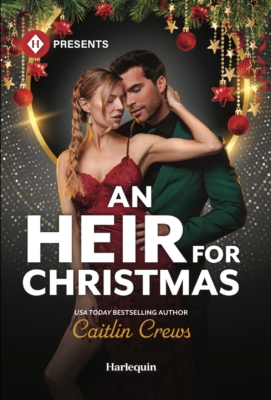
An Heir for Christmas
Their night before Christmas…
left her with a secret!
Facing new boss, Antonluca Aniello, Hannah Hansen realizes he’s the reason she lost her last job. Worse? He’s also the anonymous man she shared one scorching encounter with… And if the merciless Italian had her fired for an out-of-context comment to the media, how will he react to discovering he’s a father?
Demand marriage. That’s what Antonluca will do. His outrage that Hannah hid his child is matched only by the need to have her back in his bed. So, this holiday season, he demands his son—and a bride!
HEAT
LEVEL:
Satisfyingly Spicy
- ROMANTIC THEMES: Boss/Secretary, Christmas, Enemies to Lovers, Friends to Lovers, Heroine On the Run, Hollywood, Italian Hero, Lovers Reunited!, Marriage of Convenience, Meddling Relatives?, Midwest Is Best, Mistaken Identity, Modern Fairy Tale, One Night with Consequences, Short Time Frame!, Secret Baby, Snowbound!, Virgin Widow
Start reading
An Heir for Christmas
Jump to Buy Links →
Listen to the Audio Excerpt →

HEAT LEVEL:
ROMANTIC THEMES:
- Boss/Secretary
- Christmas
- Enemies to Lovers
- Friends to Lovers
- Heroine On the Run
- Hollywood
- Italian Hero
- Lovers Reunited!
- Marriage of Convenience
- Meddling Relatives?
- Midwest Is Best
- Mistaken Identity
- Modern Fairy Tale
- One Night with Consequences
- Short Time Frame!
- Secret Baby
- Snowbound!
- Virgin Widow
INSPIRATION:

Chapter One
Hannah Hansen made her way into work one morning that December fairly bursting with the holiday spirit.
Part of it was the gorgeous Italian scenery that beckoned from every direction. The hills were browner this time of year, the skies less gold and blue, but Hannah thought that only made the magic of Tuscany more apparent. That magic was in the mist that clung to the hills and the church steeple. It was there in the quiet stone streets of the hilltop village she drove through today, the one she was coming to consider her home. This was a magic that was right here, all year long, stamped down into the earth like its long history even when the bustle of tourists was gone.
There was something about Italy in the cold that made her heart ache in all the best ways.
Especially during the Christmas season.
It had been a difficult decision to leave the United States behind three years ago. It wasn’t something Hannah had ever imagined she would do, but then again, there were a lot of things about the last few years that she never could have imagined in advance.
This morning she had left the best of those things—her son, the sweet and good-natured Dominic—playing merrily with his toys in the care of the marvelous Cinzia. Cinzia, who had started as the landlady, had become the very best neighbor imaginable. And she was now, for all intents and purposes, the family Hannah had always wished she had.
Instead of the family she did have, all of them still clustered together in a scrum of judgment and shame in a tiny town outside of Omaha, Nebraska.
The prospect of Hannah having a baby out of wedlock had scandalized them all. How can we hold up our heads at the market? her sister had asked once.
In all seriousness.
This and many other similar interactions were why Hannah had decided, at six months pregnant while she still had some savings left, that she deserved better than being treated like the blackest of black sheep in the state of Nebraska. With a set of scarlet letters to boot.
And she had always dreamed of going to Italy one day, because didn’t everyone? So she decided that one day had come. She’d bought herself a one-way ticket to Florence, the city that had inhabited her dreams for as long as she could remember. She’d wandered about piazzas, ate too much gelato, and spent too many nights in lustily robust trattorias before making her way to a tiny little village out in Tuscany’s undulating hills that felt familiar the moment she saw it. As if she’d always been meant to find her way here.
Aside from the fate aspect of it all, she was pretty sure she’d read about this village once, back when she’d still been living in New York City.
New York City.
She shivered a little as memories of that frenetic, exuberant city and her time there washed over her once again. The way it always seemed to do no matter how many times she assured herself that she was done looking back.
Hannah blew out a sigh as she navigated her way through the narrow streets of the ancient village that clung to the side of the hill, stones steeped in thousands of years of history. She followed the winding road down toward the fields again, and tried to breathe deep a few more times as she headed up another rolling hill on the far side.
It was hard to imagine on crisp and beautiful December mornings in Tuscany, far away from any sort of city, that she’d ever lived in the thrilling, overwhelming, concrete sprawl of Manhattan. Like she was remembering a television show, not her own life. Because those short, busy, overwhelming years seemed like not just a different life entirely, but something she might have dreamed up one night. One of those dreams that didn’t go away in the morning, but lingered on forever.
“And then ended poorly,” she muttered to herself as she crested the hill, lest she forget the crucial part of her Manhattan years.
Though Dominic made up for pretty much anything and everything that might have happened before his birth.
But she stopped thinking about the past then, because the view before her opened up again.

She sighed again, but happily this time, the way she always did at this point in her drive to work from her darling cottage on the other side of the village. Because there, lolling across the spine of the next rolling Tuscan hill, was the estate.
Not quite a castle in any classic sense, it was a collection of manor houses strung along the hillside like a necklace fit with jewels that some indolent Italian noble had tossed aside on his way to some or other Renaissance. Once the home of a succession of minor nobles, the estate had fallen into disrepair by the early twentieth century. It had been bought and toyed with by one optimistic and/or wealthy individual after the next since then, because the vineyards still produced rich red wines and the cypress trees still marked the age-old roadways. It was a place that seemed half sky, half ancient earth, strung round with olive groves, lavender, and vines of determined wisteria.
But a place like the estate required vision to fully resurrect, and so it had stood dormant for some time.
In the village, they called the attempt to launch a pile of stones and abandoned houses into something luxurious una follia, a folly.
Nonetheless, some ten years ago, the wife of the extremely wealthy Italian businessman who had recently claimed the place had taken it as part of her divorce settlement. She had then renovated the whole of the estate, transforming it into a hotel that exuded style from every newly polished stone. La Paloma, as both she and the estate were known, was infamous for her deep delight in taking petty revenge on those she felt wronged her—meaning, all of her ex-husbands, and she’d racked up a fair few—as well as her architectural flair and eye for design.
Hannah had walked into the hotel a scant ten days after she’d arrived in Italy, the gluttonous week in Florence behind her, because she knew she needed to find a job. She had driven into this village, overcome with that sense of homecoming. She’d eaten in the tiny trattoria in town, and had watched the old men gather in the square. She had stayed in a pensione a bit of a walk from the center of the village, and it was while walking back to her room that she’d seen the estate on the hill.
It was so beautiful. That had been her first thought.
When she’d learned that it was a hotel, she’d been thrilled. Because she could work in a hotel. It had to be better than a restaurant. Because anything was better than the nightly chaos of a restaurant.
She had pled her case to the hotel manager when she’d presented herself at the front desk, though she glossed over the reasons she’d left her last position of managing a Michelin-starred restaurant in New York. She’d focused more on the fact that she’d worked in hospitality for her whole career. And more, that she had just moved to the area and would be delighted to work in any potential open position he had—because it was clear that La Paloma was destined to become the uncontested gem of the region, polished as it was to such a bright and glorious shine.
But the hotel manager had looked at her belly, sneered, and only then looked her in the face. Perhaps la signora should be at home with her husband, awaiting this most blessed event. This would surely be a better use of your time.
He did not say and mine. Though it was heavily implied.
La Paloma had descended upon them then, appearing in a cloud of scent and fury as she wafted her way into view. She was a formidable woman in every regard. She was the kind of skinny that was best suited by bespoke couture garments from ateliers in places like Milan and Paris, all of which hung perfectly on the sort of ruthlessly emaciated body that was more an advertisement of determination and self-control than any aesthetic. She had waved one bejeweled finger at the hotel manager.
Perhaps you should take your own advice, Raffaele.
And that easily, Hannah was hired.
La Paloma, champion of women though not one to go easy on anyone, had tossed Hannah directly into the deep end. She’d informed Hannah that she had two weeks to figure out the manager’s job and to excel at it. If she managed this feat, the position was hers. Complete with maternity leave.
That is remarkably kind, Hannah had said in sheer wonder as the furious Raffaele took his leave.
I’m never kind, La Paloma had told her, her dark eyes gleaming. But I like to think that I can spot a diamond in the rough, my dear girl. And I know how to make one gleam.
As if the diamonds dripping off of her didn’t tell the same story.
Hannah, obviously, had made certain to exceed the older woman’s expectations.
When Dominic was born, she had taken a month of leave and then had returned to work. She stayed mainly in her office so that she could keep the baby with her as much as possible and tend to what matters she could from there, since the guests certainly did not need to see the hotel manager’s private, domestic affairs.
When he was six months old, Cinzia had offered to watch Dominic whenever Hannah was working, and that was that.
She had somehow stumbled into this beautiful little life that fit her well, made her happy, and as far as she could discern, could not possibly be better in any regard. She loved what she did. She loved the hotel, was eternally indebted to La Paloma, and enjoyed the demands of her position and all the problem-solving it entailed.
Best of all, no one in the hotel was in the habit of flinging food in her direction, like the overwrought chef she’d had to contend with back in New York.
Tuscany might have been like a dream, but these days it was Hannah’s dream come true.
She parked her little car in its usual place in the staff parking area, and stepped out into the chill of the morning.
It was lovely and quiet today, with a cold wind dancing high above and scrubbing the sky clean. The hills rolled away toward the horizon, a more muted green than their summer splendor, but that did not make them any less beautiful. While she’d grown up in Nebraska, she often dreamed of places like this. Magical places so far away from what she thought of as real life. Fairy tales made real, and beautiful, in sophisticated settings far, far away from her small town life.
Her family had always teased her for that, and not always good-naturedly. They’d loved nothing more than to tell her that the real world wouldn’t be kind to a girl who lived and breathed fantasies the way she did.
So she’d proved them wrong, obviously.
She’d gone to college and found her way into the hospitality field. They had expected her to return home, and possibly move as far away as Omaha, a solid forty-five-minute drive away from her childhood home. They had all found it flashy and tasteless that she’d instead gone off to a terrible din of a place like New York City. And worse, had dressed like the sort of person who would be successful in New York City—as if you really think you’re going to make it, her sister had said one Thanksgiving with a derisive laugh.
But of course she felt that way. They all felt that way. They found it unimaginable that Hannah started off right out of college working in hotels so luxurious that no one from her entire hometown could imagine that anyone would spend that much money on a single night’s stay. Much less go to a restaurant that charged even more.
Hannah had learned to downplay her initial run of success because they all found even that garish and showy. Or maybe it was that they thought she was.
At a certain point, she thought now, she’d had to accept that the common denominator in the things her family didn’t like about her…was her.
Something that had become very clear and impossible to ignore when she’d gone home after losing her job at the restaurant.
She stood where she was, there near the parking area that was part of an ancient forecourt. In every direction, she was surrounded by the hills of Tuscany, the trees that seemed almost like heather this time of year—dressed in russets and deep autumn colors—and the winter vineyards slumbering in the cold ground. It was a sunny day now, if cool, with the morning mist burning off even as she watched.
Hannah took a deep breath, as if blowing it out again could scrape her family directly out of her system. That little sniff her mother liked to make. Her sister’s arch, judgmental asides. Her father’s quiet disapproval.
The fact that not one of them had reached out after she left at six months’ pregnant. She’d been the one to let them know that she’d settled in Italy when, three weeks after she’d left, there still hadn’t been so much as a text.
For all they knew, she’d been living rough somewhere.
Of course you’ve moved to Italy, of all places, her mother had said with a sniff. Typical Hannah.
It had baffled her then. It still did.
Though there was no mystery as to why she was thinking about them now, she acknowledged. It was December. Christmas was coming. And despite her very real and very hard feelings about the way they’d treated her—and had always treated her—try though she might, Hannah couldn’t bring herself to love them any less.
Especially at this time of year.
“Love doesn’t mean full access,” she murmured to herself. The way she often did because it was supposed to be soothing. “I can love them from afar.”
She called home every Sunday and made herself suffer through the usual stilted conversation, in which her parents acted as if she’d had their grandchild simply to spite them. She’d stopped asking them to come visit, because they wouldn’t. But Dominic deserved to know his family, she reasoned, and to make his own decisions about whether or not he wanted them in his life. She couldn’t make that decision for him.
Maybe, she liked to tell herself, she would stop calling one day. But deep down, she knew that if she did, she would never hear from them again. Something about that continued to hurt too much.
“One day,” Hannah promised herself under her breath, “it won’t hurt at all.”
One day.
But today, there were far more exciting things to think about than tired, old family dynamics.
She smoothed down the front of her dress as she walked toward the entrance to the hotel, swinging around to the front of the main building because she always liked to get a sense of the place as if it was new. As if she was a guest arriving for the first time.
The main building looked like an ancient fort built around a bell tower, though the old stone gleamed these days. The entrance itself was wide and welcoming, with evergreen displays wrapped in lights as a nod toward the season. Even looking at it made her feel peaceful.
This was how Hannah wanted the whole hotel to feel.
This was particularly how she wanted this Christmas season to feel.
And so it will, she assured herself as she walked. She adjusted her flowy, soft wool wrap on her shoulders and gripped the leather folder in her hand tightly.
La Paloma was a woman of many projects and a deep well of boredom. Or so she had told Hannah one night as they sat together in the finest suite in the hotel, which was, of course, the only place she would stay when she visited. She served only vodka gimlets and insisted that anyone who she invited to join her drink up.
And Hannah had never met anyone who argued with La Paloma.
I’ve sold the hotel, her benefactress had told her.
It had been two weeks ago now, out of the blue. But that was La Paloma.
But don’t fret, my dear girl, I have made your continuing employment condition of the sale. To tell you the truth, I think you will be delighted.
Hannah had spent a lot of time working with the older woman over the past couple of years. She was not quite as overawed by La Paloma as she had been at the start. But that didn’t mean she didn’t maintain a healthy level of respect. This was the only reason that she didn’t respond immediately to express how extremely not delighted she was by this development.
This place is special to me for many reasons, La Paloma had continued, waving her gimlet in the air the way she liked to do, for drama and emphasis. Not that she ever spilt so much as a drop. Not least of which is that it was once a prize possession of my ex-husband, upon whom we wish every last thing that he richly deserves. But it is also unique in that it gave me something of a blank canvas, and I find that what I have done here has pleased me excessively. In every possible way.
She had sighed then, as if congratulating herself. I knew that I could not sell it to the typical portfolio-hoarding financier, or any other such person. It could only be a friend.
Hannah had made herself smile. With apologies, madam, but I was under the impression that you did not suffer friends.
Paloma laughed. So needy. So grasping. But no, darling, I’m a great fan of friendships that run precisely as I wish them to run. In this case, we are speaking of a local friend, who I’ve known for some time. I met him when he was very young, brash, and edgy. Now he is… How do I put this? Something of a grumpy hermit who likes his village as it is. Sleepy. Undisturbed.
Another wild swing of her drink, yet still no drop fell.
I informed him that this hotel was only going to grow in stature and desirability, and he could either fume about it, or get involved. He chose the latter.
You are very persuasive, Hannah had said.
Indeed I am, La Paloma had agreed, with a smile that might have appeared demure on someone else. On her it was nothing but an expression of power. You will meet with him when he gets back from whatever trip he’s currently on, doing whatever it is wealthy men do with their time.
But she had laughed as if she knew very well what that was.
I told him you would explain the Christmas Jubilee that you have planned and walk him through the reservations, the festivities, and all the rest. I’m sure he will wish to put his stamp on things, as all men do, but I’m also certain that he will be deeply impressed with you.
The older woman had smiled then, wider than before, and lifted her glass in Hannah’s direction. Because I am, you see, and I am not impressed by anything.
It was only later, when she’d been cuddled up with Dominic and kissing his sweet head as he tried valiantly to fight off sleep, that it occurred to her that what Paloma had done was flatter her into acquiescence.
Not to mention a headache the following morning.
But now the day and the great man had arrived.
The whole hotel had been aflutter for two weeks. Il maestro, they had murmured, sometimes like prayers and sometimes like wild chants to the moon. Il maestro sta arrivando qui!
The master was coming here.
Hannah had no idea who the master was.
But she had learned early on in her career in hospitality that if she defaulted to her knee-jerk, Midwestern politeness, people made all kinds of assumptions about her. Mostly that they could treat her badly. So she had quickly developed a sleek, cool exterior. She’d learned how to do her blond hair in an icy sort of twist that sat at the nape of her neck, because she’d understood that elegance was a weapon when wielded correctly.
The more understated, the better.
She’d learned that walking in extremely high heels that looked as if they would break anyone else’s ankles like twigs conveyed an air of authority that no flat shoe ever could, so she’d practiced in her tiny New York apartment until she could play basketball in her heels, if necessary.
And she’d learned that the people who responded best to all of this were the kind of overtly wealthy, wildly arrogant clientele used to getting their own way, who frequented five-star luxury hotels like this one.
She had also learned that while friendliness was never out of place, becoming too friendly with staff she might eventually have to fire hurt everyone, herself included. So Hannah did not sit down for any cozy chats with the rest of the staff about il maestro, whoever he was. Asking any of the staff who, exactly, this person was would be tantamount to admitting that she wasn’t in control of every last detail in this hotel.
Hannah worked extremely hard to make it clear to everyone and anyone that she was more than in control.
That she was, in fact, the fuel that kept the whole place running smoothly.
This morning she walked inside the way she always did, in shoes that made other women wobble on the street. She pretended not to notice the way everyone scurried about at the sight of her. Everyone stood straighter, fixed their uniforms, and schooled their expressions to a pleasing blandness. She even saw one of the women behind the desk try to surreptitiously straighten one of the floral arrangements when it was already a symphony of vertical blossoming that needed no encouragement.
Hannah bit back a smile, inclined her head at everyone who caught her eye, and marched herself straight into her office. Inside, she had pictures only of the hotel, the hills, the glorious landscape stretched out in all directions.
No pictures of the baby. No pictures to indicate that she had any kind of personal life at all.
She had learned that lesson entirely too well in New York.
A glance at the slim gold watch on her wrist assured her that she still had time before the meeting. She was twenty minutes early, which was close enough to late for her. Hannah settled into her desk chair and fired up her desktop computer, then set about putting out a few fires that had blazed to life overnight.
But New York was in her head again. Hannah didn’t like to think about New York. About how she trusted her friend, back when she’d had what passed for a social life in the hours she wasn’t working at that restaurant. She had trusted her friend, she’d been indiscreet in what she’d thought was a safe space, and then she’d found her comments all over the news.
Manager of New York’s favorite new hotspot doesn’t like the food, they had all crowed.
It had been like a nightmare, but Hannah had never managed to wake up. Her phone had been filled with messages from all of her friends at work, wondering what on earth had possessed her. And from the obnoxious head chef himself, who had called her names she didn’t like to think about, even all these years later.
She was surprised they hadn’t fired on the spot, but had instead forced her to work the busy weekend ahead. And she had only realized afterward that it had been a kind of exercise in public shame. Because every single person who had walked in that door that weekend had asked her if she was the one who’d been quoted, and when she’d said yes—because she might have been a fool but she wasn’t a liar—had delivered a litany of hot takes on how wrong she was. Or had asked her to point out the parts of the extraordinarily expensive menu that were, in her own words, up themselves.
It would have been far preferable to have simply been fired on the spot.
Maybe she should have quit, but she’d held on to some slim thread of hope that maybe, if she showed that she was still the same hard worker she’d always been, they might rethink one indiscretion…
They had not.
And then on Sunday night, after her last shift—during which not one single person who worked at the restaurant would look her in the eye or speak to her directly—he had appeared.
By then she had accepted that she was getting fired. Because if she hadn’t been, she was sure that she wouldn’t have allowed the tall, almost brutally handsome man who’d watched her so intently from the bar to take her home.
She’d known that all the work she put into her life was about to be taken away from her. Worse, that it was her fault. She never should have trusted that she was in a safe space, not when the restaurant she worked at was the toast of New York.
It was the latest restaurant created by the billionaire restauranteur Antonluca. Once considered the greatest chef in the world, he had stopped cooking years ago and had turned his attention to a series of astonishingly good restaurants all over the world. He had even put together a series of television shows, none of which he appeared in, that had introduced an international audience not simply to his take on food but what many critics had dubbed the Antonluca dining experience.
Hannah had managed to be a part of all that, and had ruined it.
The man who’d turned up late and had watched her from the bar had seemed like an escape.
There was something about him. Stormy gray eyes. Close-cropped, inky black hair. He had been dressed in what should have been casual clothes—a button-down shirt thrown over trousers—but there was nothing casual about him. Maybe because it was clear at a glance that he was not American. American men never seemed so polished, nor so effortlessly beautiful. Even if it was his kind of beauty, that had seemed sharp at the edges.
The way she remembered it, she been drawn to him like he had her in some kind of tractor beam. Like she was helpless to resist.
You look unhappy, cara, he had said when she’d ventured near to pick up another silent order from the bartender she’d considered a friend, who had been acting as if she was a ghost.
What is happiness, really? she’d replied, realizing after she said it that it came out far more flirtatiously than she’d intended.
Maybe because she was so happy that someone was talking to her.
Something had shifted in that dark gray gaze of his. But if she’d expected him to flirt back at her, she was surprised. He had answered her question seriously.
To me, he had said, something intense in his gaze and all over his astonishingly perfect face, chiseled and male and beautiful, happiness is never the goal. It is too often used to achieve things that cannot matter. Do you not think? When truly, it is joy or pain that we remember, in the end.
He had said these things to her so intently. He had looked at her as if no other person existed in the world.
Looking back, was it any wonder that when he’d held out his hand, she put hers into his grasp without a second thought? It’d been a handshake, at first. When they’d still been in the restaurant.
Then, later, he had taken her in hand again. And he had taught her things that she still found herself dreaming about, all these years and his baby later.
She still didn’t know his name.
But when they had fired her the next day, calling her into the restaurant and dismissing her, she’d taken it better than she might have otherwise. Because there was him to remember. There was that long, wildly hot night. She had lowered her eyes and had attempted to look meek and remorseful while the chef and Antonluca’s business manager had decimated her.
Yet what she’d been thinking about was the way that beautiful man had moved inside of her. How he had kept her gasping and sobbing, trembling and begging, into the wee hours.
It had been like a balm.
Two months later, when she’d moved back to Nebraska because her name was poison in New York restaurant circles, it had been a bit less of a balm. Because she still didn’t know his name. He hadn’t given her that or his number or anything else. She wouldn’t have the slightest idea how to go about finding him, even if she could call the restaurant and ask them to go through the receipts of that night—and she knew they wouldn’t help her. Even if they might, she hadn’t seen what he was drinking.
She’d thought it was a bit magical until then. She’d had this whole night out of time. A memory to tuck in her pocket and keep with her, something that was entirely hers and that no one else would ever have to know about.
Because, of course, she had not intended to get pregnant.
Then again, maybe things worked out the way they should, she thought as she checked her watch again and stood up. She set her computer to sleep, and picked up her folder once more. Because she now could not imagine a life without Dominic. Just as she couldn’t imagine living anywhere but here. She had grown accustomed to Tuscan hills and cypress trees. And while her Italian was not fluent, it was getting there. She’d had her first dream in Italian a few months back and she loved thinking in a different language. Seeing and interpreting the world through the lens of a different vocabulary.
She also loved the small community she’d built here. She wasn’t sure that she’d ever trust a friend again, but slowly, Cinzia had made inroads. Not that Hannah ever intended to repeat her error, but she did feel that since she trusted her landlady and neighbor with her child, she could probably also trust her with anything else.
After what had happened in New York, and that particular ex-friend’s noted lack of remorse, that, too, felt like a balm.
So, too, did the hilltop village. There wasn’t much to it. The trattoria. A tiny market. A handful of other shops that seemed open on a whim, if then. All arranged around the little square where there was a war memorial and the old men sat about and told lies about beautiful women they had known in their youth.
It was a sweet, good life. Hannah would raise her son here and Dominic would learn the good things in life first so that when he encountered the bad, he would have all this goodness built up ahead of time. Like armor.
All she had to do today was convince the new owner—the maestro—that she had everything in hand.
“Nervous?” asked the concierge, a fiercely French woman named Léontine, who was the closest thing that Hannah had to a friend at work. And who was also giving her French lessons twice a week, to expand Hannah’s ability to interact with their international clientele.
If anyone else had asked her, she would have made it clear that the question was inappropriate. But this was Léontine, and Hannah could tell by the way she was asking it that she didn’t think Hannah was nervous, nor should be. She was simply bracing. It was part of her charm.
“I’m not nervous at all,” Hannah replied, which was true. She had always loved the art of pitching. She’d practiced it when she’d marched herself into this hotel, six months’ pregnant and here on a tourist visa. If she wasn’t good at selling herself, she wouldn’t be any good at her job, which required that she sell the concept and fantasy of this hotel to everyone, including its owner. “But I’m used to La Paloma. I spent a long time learning how to handle her idiosyncrasies.”
“Yes, but this is a man,” Léontine said with a particularly French sort of shrug. “Whatever idiosyncrasies a man has, they are always…easily handled, in the end. Every woman must know this is so.”
And Hannah wanted nothing more than to stand there and quiz her on what, precisely, she meant by that. But she couldn’t, and not only because that would betray how very little experience Hannah had ever had with men. Something that she thought made her seem…odd, at best. And not in a good way. Odd in a way that led to pity, or worse, offers to set her up on dates she didn’t want with men that she knew in advance she would dislike.
More pressingly, she could not risk being late. She smiled at her not-quite-friend and set off, marching through the grand lobby and making certain that everything was perfect as she passed. Every room was spacious, elegant, and set with windows that let Tuscany inside. At this time of year, the hotel was also sparkling and bright. Elegance gleamed from every direction. It was warm, inviting, suggesting Christmas without tipping over into the kind of raucous, American holiday displays that would be everywhere back home.
Suggestion was always more seductive than excess. Hannah had learned that in school and had seen it play out in each of her positions so far, though never so much as here.
Off the lobby, she made her way down the hallway that led to one of the hotel’s restaurants, a few of its shops, and beyond it, what was known as the library.
She stepped inside at precisely eight o’clock. Extremely early by Italian standards, but she’d imagined that was part of the test.
Because no matter what La Paloma might have said about her position being secure, Hannah knew that this was a test.
She stepped inside, closing the door behind her, and was already letting her lips curve in polite greeting as she walked toward the figure of a man that she could see standing there by the window.
But he turned.
And she stopped dead.
She was fairly certain that her smile tumbled straight off of her lips and crashed down at her feet—but it could also have been her heart.
Because it was him.
Him.
Her mystery man from New York City.
Her balm during the hardest weekend of her life.
This beautiful, brutally attractive man, who had fully taken her hand. And had then taken her innocence, too, and had left her full of dreams of him for years after.
This man who had not given her his name, but had given her a far greater gift.
Her son.
And as his dark gray gaze locked on to hers, then widened in dark, arrogant astonishment, something else occurred to her.
This man was the father of her son. And he didn’t know it. He couldn’t.
And unless she was wildly mistaken, or in the wrong meeting room, he was also the new owner of this hotel.
Which meant that the life Hannah had built so carefully, and loved so much, was about to come tumbling down.
Again.
End of excerpt
Audio Excerpt
An Heir for Christmas
Rebel Heart Books is my absolute favorite bookshop. I'd love it if you'd support this delightful, woman-owned place. You can also get signed copies! Check here to see if this book is available through them.


An Heir for Christmas
is available in the following formats:
eBook:
Print:
United Kingdom


